Division 33 – Intellectual and Developmental Disabilities / Autism Spectrum Disorder
Poster Session II, 10:30 am to 11:30 am, Saturday, August 8
APA Annual Convention 2026, August 6-8; Washington, D.C., USA
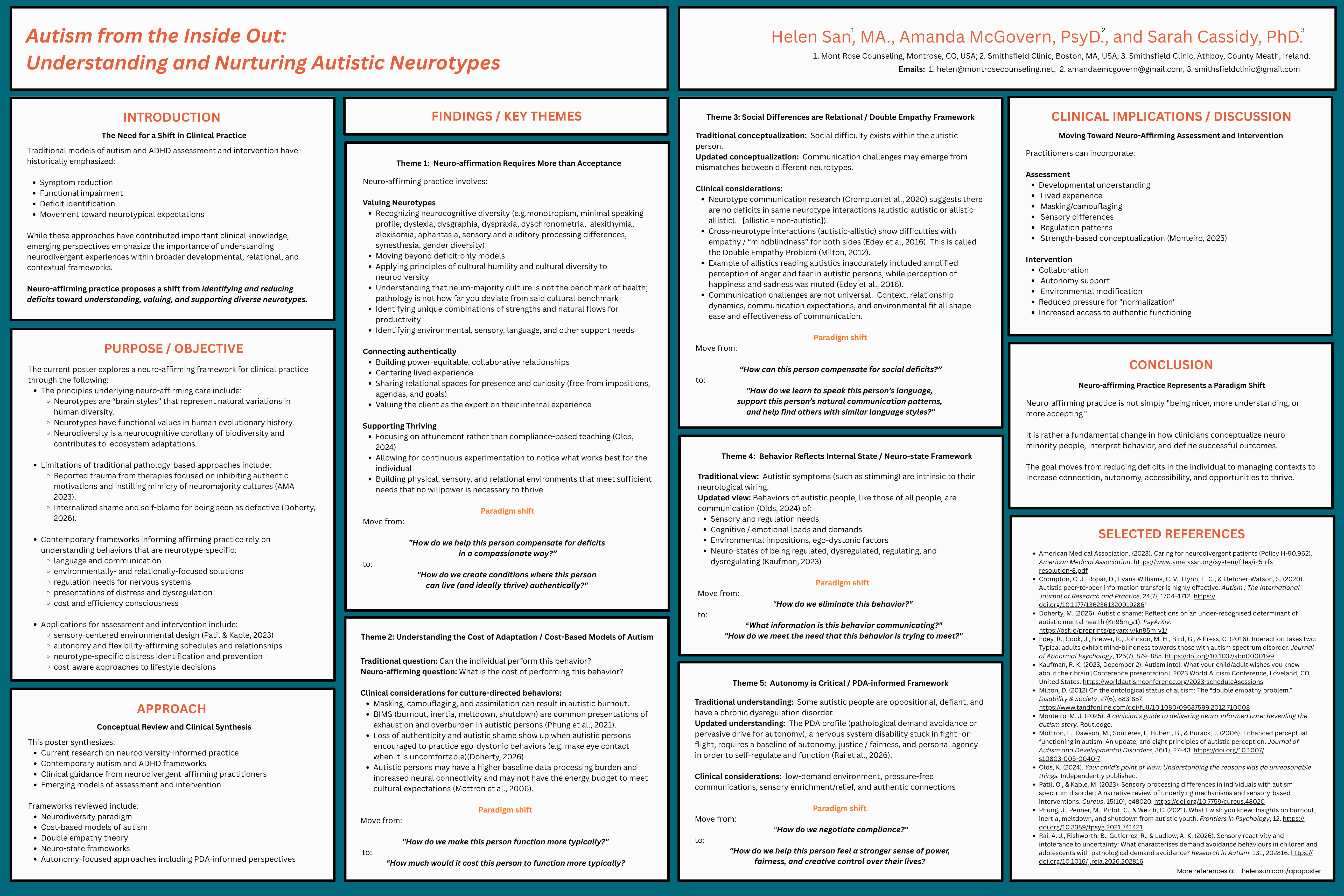
Autism from the Inside Out: Nurturing and Understanding the Autistic Neurotype
Additional references for these sections.
Theme 2: Understanding the Cost of Adaptation / Cost-based Models of Autism
Clinical considerations for culture-directed behaviors:
- Masking, camouflaging, and assimilation can result in autistic burnout (Evans et al., 2024; Chapman et al., 2021).
- BIMS (burnout, inertia, meltdown, shutdown) are common presentations of exhaustion and overburden in autistic persons (Phung et al., 2021; McGuinness, 2021).
- Loss of authenticity and autistic shame show up when autistic persons encouraged to practice ego-dystonic behaviors (e.g. make eye contact when it is uncomfortable)(Doherty, 2026).
- Autistic persons may have a higher baseline data processing burden and increased neural connectivity and may not have the energy budget to meet cultural expectations (Mottron et al., 2006; Bowling & Klann, 2014; Columbia University Irving Medical Center, 2014; Kim et al, 2017).
Theme 3: Social Differences are Relational / Double Empathy Framework
Clinical considerations:
- Neurotype communication research (Crompton et al., 2020) suggests there are no deficits in same neurotype interactions (autistic-autistic or allistic-allistic). [allistic = non-autistic]).
- Cross-neurotype interactions (autistic-allistic) show difficulties with empathy / “mindblindness” for both sides (Edey et al, 2016; Cheang et al., 2024). This is called the Double Empathy Problem (Milton, 2012).
- Example of allistics reading autistics inaccurately included amplified perception of anger and fear in autistic persons, while perception of happiness and sadness was muted (Edey et al., 2016).
- Communication challenges are not universal. Context, relationship dynamics, communication expectations, and environmental fit all shape ease and effectiveness of communication.
Theme 5: Autonomy is Critical / PDA-informed Framework
Traditional understanding: Some autistic people are oppositional, defiant, and have a chronic dysregulation disorder.
Updated understanding: The PDA profile (pathological demand avoidance or pervasive drive for autonomy), a nervous system disability stuck in fight -or-flight, requires a baseline of autonomy, justice / fairness, and personal agency in order to self-regulate and function (Rai et al., 2026; Klein, 2025).
References
American Medical Association. (2023). Caring for neurodivergent patients (Policy H-90.962). American Medical Association. https://www.ama-assn.org/system/files/i25-rfs-resolution-8.pdf
Bowling, H. & Klann, E. (2014). Shaping Dendritic Spines in Autism Spectrum Disorder: mTORC1-Dependent Macroautophagy. Neuron, 83 (5):994-6. doi: 10.1016/j.neuron.2014.08.021
Chapman, L., Rose, K., Hull, L., & Mandy, W. (2022). “I want to fit in… but I don’t want to change myself fundamentally”: A qualitative exploration of the relationship between masking and mental health for autistic teenagers. Research in Autism Spectrum Disorders, 99, 102069. https://doi.org/10.1016/j.rasd.2022.102069
Cheang, R. T., Skjevling, M., Blakemore, A. I., Kumari, V., & Puzzo, I. (2024). Do you feel me? Autism, empathic accuracy and the double empathy problem. Autism : the international journal of research and practice, 13623613241252320. Advance online publication. https://doi.org/10.1177/13623613241252320
Columbia University Irving Medical Center. (2014, August 21). Children have extra synapses in brain.
https://www.cuimc.columbia.edu/news/children-autism-have-extra-synapses-brain
Crompton, C. J., Ropar, D., Evans-Williams, C. V., Flynn, E. G., & Fletcher-Watson, S. (2020). Autistic peer-to-peer information transfer is highly effective. Autism : the international journal of research and practice, 24(7), 1704–1712. https://doi.org/10.1177/1362361320919286
Doherty, M. (2026). Autistic shame: Reflections on an under-recognised determinant of autistic mental health (Kn95m_v1). PsyArXiv. https://osf.io/preprints/psyarxiv/kn95m_v1
Edey, R., Cook, J., Brewer, R., Johnson, M. H., Bird, G., & Press, C. (2016). Interaction takes two: Typical adults exhibit mind-blindness towards those with autism spectrum disorder. Journal of Abnormal Psychology, 125(7), 879–885. https://doi.org/10.1037/abn0000199
Evans, J. A., Krumrei-Mancuso, E. J., & Rouse, S. V. (2024). What You Are Hiding Could Be Hurting You: Autistic Masking in Relation to Mental Health, Interpersonal Trauma, Authenticity, and Self-Esteem. Autism in Adulthood: Challenges and Management, 6(2), 229–240. https://doi.org/10.1089/aut.2022.0115
Kaufman, R. K. (2023, December 2). Autism Intel: What your child/adult wishes you knew about their brain. Conference presentation. 2023 World Autism Conference, Loveland, CO, USA. https://worldautismconference.org/2023-schedule#sessions
Kim, H.J., Cho, M.H., Shim, W. et al. (2017). Deficient autophagy in microglia impairs synaptic pruning and causes social behavioral defects. Molecular Psychiatry 22, 1576–1584. https://doi.org/10.1038/mp.2016.103
Klein, A. (2025, March 7). Professionals Breakout Workshop. Conference presentation. PDA North America Annual Conference 2025, Skokie, IL, USA.
McGuinness, K. (2021). An evaluation of a tool, based on spoon theory, to promote self-regulation and avoidance of burnout in autistic children and young people. Good Autism Practice (GAP), 22(1), 59–72.
Milton, D. (2012) On the ontological status of autism: The “double empathy problem.” Disability & Society, 27(6), 883-887. https://www.tandfonline.com/doi/full/10.1080/09687599.2012.710008
Monteiro, M. J. (2025). A clinician’s guide to delivering neuro-informed care: Revealing the autism story. Routledge.
Mottron, L., Dawson, M., Soulières, I., Hubert, B., & Burack, J. (2006). Enhanced perceptual functioning in autism: an update, and eight principles of autistic perception. Journal of autism and developmental disorders, 36(1), 27–43. https://doi.org/10.1007/s10803-005-0040-7
Olds, K. (2024). Your child’s point of view: Understanding the reasons kids do unreasonable things. Independently published.
Patil, O., & Kaple, M. (2023). Sensory Processing Differences in Individuals With Autism Spectrum Disorder: A Narrative Review of Underlying Mechanisms and Sensory-Based Interventions. Cureus, 15(10), e48020. https://doi.org/10.7759/cureus.48020
Phung, J., Penner, M., Pirlot, C., & Welch, C. (2021). What I wish you knew: Insights on Burnout, inertia, Meltdown, and shutdown from autistic youth. Frontiers in Psychology, 12. https://doi.org/10.3389/fpsyg.2021.741421
Rai, A. J., Rishworth, B., Gutierrez, R., & Ludlow, A. K. (2026). Sensory reactivity and intolerance to uncertainty: What characterises demand avoidance behaviours in children and adolescents with pathological demand avoidance? Research in Autism, 131, 202816. https://doi.org/10.1016/j.reia.2026.202816