There are many parenting movements out there, such as Love and Logic and Gentle Parenting. I call my model Attunement-based Parenting. It relies on deep listening and curiosity. The Gottman Institute (2014) actually has an acronym for attunement in their couples therapy: Awareness, Turning toward, Tolerance, Understanding, Non-defensiveness, and Empathy. What works for couples can also work for parent-child relationships.
Why attunement-based parenting?
It is the only one I have found that works with PDA, and the one that works the best with autism and ADHD neurotypes. Most parents have already tried traditional authority-based parenting and compliance-based teaching. They have already found that punishments and consequences make things worse. It escalates.
Attunement-based parenting takes a long time to implement, because it is based on trust, and trust is slowly earned, both ways. Many parents give it a brief try, and then revert back to compliance-based teaching because, like growing a tree, it does take a long time. But when the tree is finally grown, it is worth it to have that trust and closeness.
Another reason is that compliance-based / authority-based parenting can result in their kids feeling like they have to hide who they are from their parents, which comes with shame and self-hatred. Kids end up only seeing what they are doing wrong, without feeling any acceptance to be able to be themselves. These feelings can end up in substance use, suicidal ideation, unhealthy relationships, and unemployment in the future. I see many late-identified autistic and/or ADHD adults who have experienced this trajectory: authority-based parenting with corrections that resulted in shame of who they are and all ensuing mental health problems.
Kelsie Olds (2026, April 26) remarks that compliance-based teaching, with the implication of “stop crying and protesting and let adults do whatever to you,” is a dangerous message to send to vulnerable children. She frames protests and despair as “annoying, obnoxious, immature self-advocacy.” She suggests that you don’t want to stop self-advocacy, you just want to help them mature.
But what about safety? Shouldn’t the child learn consequences to avoid making serious mistakes? Olds (2026, June 22) advocates solving the problem with environmental design and support (without dampening natural curiosity), rather than solving the problem by causing intimidation and fear.
By the way, I absolutely adore Kelsie Olds, who is known on the internet as The Occuplaytional Therapist. If I rub you the wrong way (cause I do that), please go to her resources (Facebook), because she communicates what I want to say in a much more effective way.
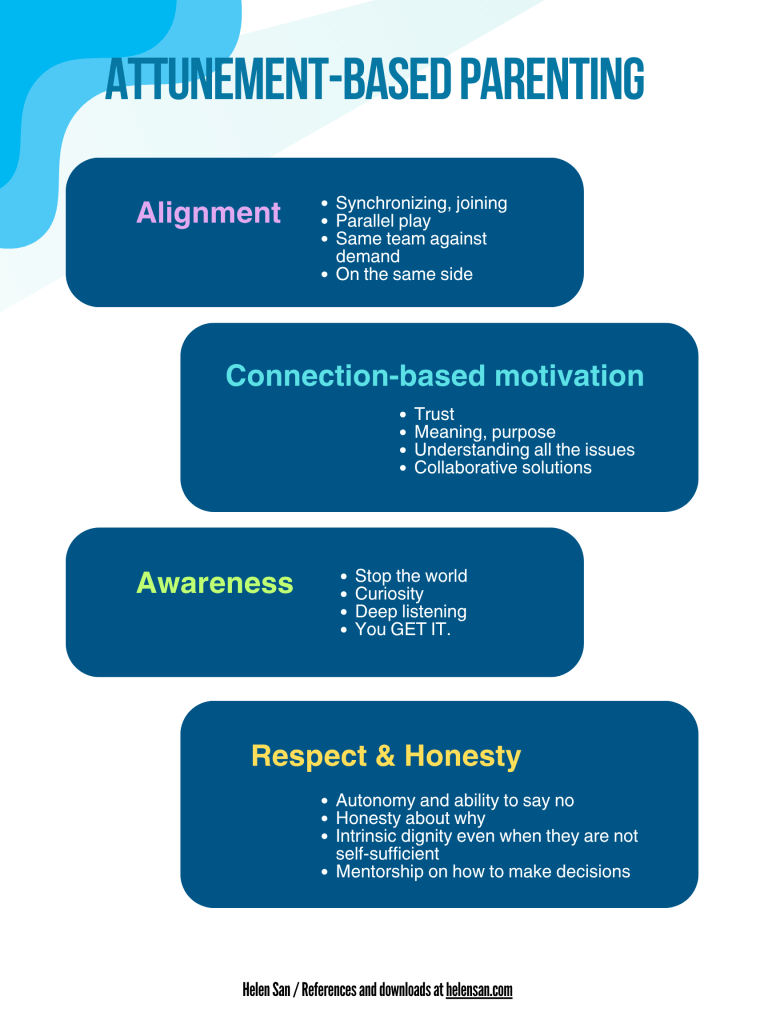
Here are four possible ways to achieve attunement.
Alignment
Communicate through actions, tone, and warmth that you are on your child’s side. It is not you vs them, but you and they together against the world. Change the relationship from adversarial to collaborative.
Enter their world instead of asking them to join yours.
Raun Kaufman (n.d.) calls it “synchronizing.” If they are spinning plates, you spin plates next to them. Marilyn Monteiro, PhD, (2026) recommends therapists have 2 of every toy so they can parallel play.
Kelsie Olds (2026, April 2) emphasizes, “The most important thing is that the child knows that you are on their team.” You are not on the demand’s side against them. You are on their side against the demand.
When a child knows, whatever they’re going through, they don’t have to go through it alone, it can become regulating.
Connection-based motivation
Traditional parenting styles assert the parent as the authority, using rewards, consequences, and withdrawal of privileges for behavior control. Authority can either be fair and logical (known as authoritative), or it can be controlling and demanding (known as authoritarian).
Attunement-based parenting relies on connection rather than authority. Connection comes with feeling understood, feeling like their internal world matters. Connection explores whether a demand has meaning and purpose for a child. Connection emphasizes trust rather than the desired behaviors. The parent trusts the child’s character and that the child would perform if they could. The child trusts the parent to have their back. They are committed to untangle the problem until the solution makes sense for both sides. Connection takes longer to figure things out, but the solutions are more sustainable in the long run.
Awareness
Awareness starts with stopping. The Gottman Institute (2017) for couples therapy says, “When you’re hurting, the world stops, and I listen.” “The world stops” is expensive to implement, when we are all busy trying to survive. In my opinion, it is the most overlooked part of parenting, to stop the world and listen to your child. Set time aside to listen. Whatever it costs.
In any parenting style (such as Gentle Parenting or Low-Demand Parenting) that does not use punishments, it can look like Permissive Parenting on the surface. Permissive Parenting is no-rules-no-punishments rooted in “I don’t have enough energy to care.” At its core, Permissive Parenting is neglect. Other punishment-free parenting is based on the opposite of neglect; it works by paying MORE attention to the child.
The quality of the attention matters. You want curiosity about the child’s inner experiences. You want to understand all the gears inside that black box. You want DEEP listening and DEEP understanding of what it feels like to be in your child’s body and your child’s world. You want your child to say, “Mom and/or Dad, you GET IT. Thank you.”
Kelsie Olds, the Occuplaytional Therapist, wrote a whole book (2024) about how to see things from your child’s point of view. It is highly recommended, as is anything Olds writes.
Respect and Honesty
Part of authority-based parenting is speaking to a child like a manager or boss: “Here are the rules and boundaries, and this is how I am going to enforce them.”
Imagine if you were on an amazing hike and met a fellow hiker on the trail. You hit it off and hike together for a while. You get to a place where you would like to ask this potential new friend for a favor. Let’s say, you want to ask them to carry your backpack for 10 minutes because your back hurts, and you need 10 minutes of relief. How would you ask for this favor?
Many people may decide to say something like, “I’m so sorry to ask, but my back is hurting. You don’t have to do it, of course, but it would be such a big favor to me if you could carry my backpack for 10 minutes to give me some relief. If not, that’s totally ok.”
Whatever you decide to say, you probably wouldn’t say, “I need you to do carry my backpack for 10 minutes. That’s your chore for this trip. If you do it, you get to have an extra 10 minutes on your phone tonight. If you don’t, you will lose your phone privileges for the rest of the evening.”
This scenario is an example of how some parents may treat strangers with more respect and honesty than we do our own children. We would respect the stranger’s autonomy and right to choose; we would be honest about why we are asking. How would you approach a colleague at work? How would you approach your spouse? Usually with respect and honesty.
Children can tell when you believe they don’t deserve the same respect and honesty you give to adults just because they haven’t become self-sufficient yet. What they want is to believe they deserve the most respect simply for being, that they have intrinsic dignity.
A final point about respect. The way you treat your children to get them to do things is the method they will accept from others to get them to do things in the future. If you don’t want a future husband or wife taking away their phone until they take out the trash, don’t teach them to be ok with that now. Treating them without respect now is grooming them to be treated without respect as adults. Mentor them now on HOW to make decisions instead of making decisions for them and expecting them to just be obedient.
In Practice
How does this work in real life?
Let’s say, a 7-year-old boy doesn’t want to brush his teeth.
Alignment: “Hey, I don’t want to brush my teeth either. I get it. Let’s not brush our teeth together, for right now!”
Connection: “I trust that you would brush your teeth if you had a good reason to. Let’s look at some reasons. We eat a lot of sugar. Let’s look at what sugar does to teeth. I trust that you would brush your teeth if you weren’t so tired or if the bristles didn’t feel bad for you. Let’s see how we can work around those things.”
Awareness: “I stopped the world, and I noticed that after 7 pm, you don’t want to do anything anymore. Everything is hard.”
Respect & Honesty: “It is completely your choice if you want to brush your teeth or not. It is your body to take care of. I have to say, honestly, it worries me a lot when you don’t brush. I worry next year we will have to go to the dentist. I worry how much that would cost. I worry about looking like a bad parent because I don’t make you brush your teeth. My worrying is my problem, not yours. You don’t have to solve my problems. But I want to solve my problems. What can I do to make sure your teeth are taken care of? How can we find a solution together?”
References:
Kaufman, R. K. (n.d.). Synchronizing with your autistic loved one’s stims is a celebration of who they are. Facebook. https://www.facebook.com/Raun.K.Kaufman/posts/synchronizing-with-your-autistic-loved-one-stims-is-a-celebration-of-who-they-ar/1368695901725397/
Olds, K. (2024). Your child’s point of view: Understanding the reasons kids do unreasonable things. Independently published.
Olds, K. (2026, April 2). If I’m starting from square one, if I have only time to tell you one thing about PDA, this is what I would say. Facebook. https://www.facebook.com/occuplaytional/posts/pfbid02iNtB7c8U5kn8MEZQQm22t5912S4wh3FmsCwAQpiMUuRV6JW9c1HPbFbPsjdBDGd7l
Olds, K. (2026, April 26). I would like to start this post by saying that this was NOT something at the school that I worked at. Facebook. https://www.facebook.com/occuplaytional/posts/pfbid02GYxYsX6z5rdwjTWro5n2acYfpgEtSsUHd9aCmgcBauWSfv93pSyfzvo4vg1mFD3ql?rdid=cd5044JgtaCTAYna
Olds, K. (2026, June 22). Let’s imagine a toddler who tries to pull the glasses off of mom’s face. Facebook. https://www.facebook.com/share/p/1CWsyJjz9L/
The Gottman Institute. (2017, March 14). Words to live by: when you’re hurting, the world stops and I listen. Facebook. https://www.facebook.com/photo.php?fbid=10154846341150865&id=149200885864&set=a.469547105864
The Gottman Institute. (2014, January 16). Emotional attunement. Gottman. https://www.gottman.com/blog/self-care-emotional-attunement/
Monteiro, M. J. (2026). A clinician’s guide to delivering neuro-informed care: Revealing the autism story (1st ed.). Routledge.

