under Reasonable Accommodations
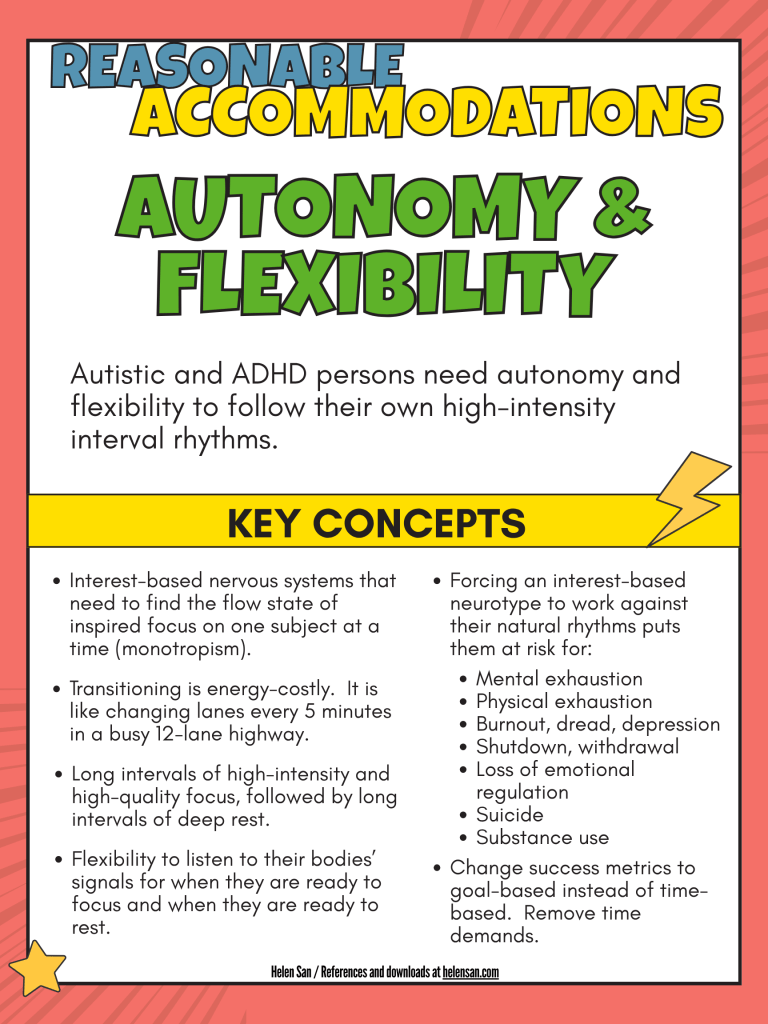
If I had to pick only one reasonable accommodation to request from a school, employer, or business contractor, it would be to allow the autistic/ADHD person to have autonomy and flexibility over their work environment and schedule. They can get the job done, but they need to do it at their own pace with deadlines of their own choosing, in an environment that fits their sensory needs.
The reason is that autism and ADHD are interest-based nervous systems (Neff, n.d.). That means motivation to complete tasks have to come from an interest drive, rather than an importance/necessity drive like it does for other people.
If you are not autistic or ADHD, think about how much motivation you have to do something that is utterly NOT important to you: e.g. meeting with a salesperson who is selling an item you don’t need. It immediately drops to the bottom of the low priority pile of never. You have limited energy and time, and you are not going to waste it on that. And you would resent any pressure to move it up in priority. Now imagine that is how much motivation your child or employee has to do the task that is not intrinsically interesting.
Once there is interest, the interest-driven neurotype can get into a flow-state of deep concentration and productivity (McDonnell & Milton, 2014). In the autism community, this deep focus is called monotropism, where all the attention resources are dedicated to one theme (Murray, 1992; Murray, 2018). Interest-driven neurotypes work in intervals of deep focus and then deep rest (Newport, 2024). Their productivity can be compared to the ocean with its own rhythms rather than a faucet that can be turned on and off at will.
What happens if an ocean is forced to suppress itself to pretend to be a faucet? Hiding natural inclinations and flow states in order to pretend to be like everyone else is called camouflaging. There is literature explaining how camouflaging can result in autistic burnout and suicidal thoughts and behaviors (Arqueros et al, 2025; Reid et al, 2024). Autistic burnout is a degradation in mental health that looks a lot like exhaustion and depression, the treatment of which is rest and relief from demands from others (Clarey et al, 2025; Dawes, 2023).
A reasonable accommodation for interest-driven neurotypes is to allow people to find their own flow states of productivity, the flexibility for them to respond to their own bodies’ signals for rest and work, and to build their own interest into the tasks they choose. Not allowing this accommodation can result in burnout, exhaustion, and deteriorating mental health.
References and more information:
Arqueros, M., Jamett-Cuevas, V., Pulgar-Vera, V., Santander-Gonzalez, R., Pemau, A., & Álvarez-Cabrera, P. (2025). Camouflaging and suicide behavior in adults with autism spectrum condition: A mixed methods systematic review. Research in Autism, 121–122, 202540. https://doi.org/10.1016/j.reia.2025.202540
Autism Foundation of Oklahoma. (n.d.). Suicide prevention. https://www.autismfoundationok.org/suicide-prevention
Clarey, M. M., Abel, S., Ireland, M. J., & Brownlow, C. (2025). Autistic Burnout on Reddit: A Sisyphean Struggle with Daily Tasks. Journal of Autism and Developmental Disorders. https://doi.org/10.1007/s10803-025-06765-4
Corwin, A. (2021, May 28). On “energy budgeting” and acknowledging internal autistic realities. Thinking Autism Guide. https://thinkingautismguide.com/2021/05/on-energy-budgeting-and-acknowledging.html
Dawes, V. (2023, February). Autistic burnout (PHS0029). UK Parliament. https://committees.parliament.uk/writtenevidence/117253/html/
McDonnell, A., & Milton, D. (2014). Going with the flow: reconsidering ‘repetitive behaviour’ through the concept of ‘flow states’. Jones,G. & Hurley, E. Eds. Good Autism Practice: autism, happiness and wellbeing. BILD, Birmingham, UK, pp. 38-47.
Monotropism: Understanding autistic ways of being through the lens of attention. (2025, September 29). Reframing Autism. https://reframingautism.org.au/monotropism-understanding-autistic-ways-of-being-through-the-lens-of-attention/
Murray, D. (1992). Attention Tunnelling and Autism. Living with Autism: The Individual, the Family, and the Professional. Durham Conference Proceedings. https://monotropism.org/dinah/attention-tunnelling-and-autism/
Murray, F. (2018). Me and monotropism: A unified theory of autism. The Psychologist. British Psychological Society. Retrieved from https://www.bps.org.uk/psychologist/me-and-monotropism-unified-theory-autism
Murray, F., & Hallett, S. (2023, January 31). ADHD and monotropism. Monotropism. https://monotropism.org/adhd/
Neff, M. A. (n.d.). How the interest-based nervous system shapes ADHD motivation and burnout. Neurodivergent Insights. https://neurodivergentinsights.com/working-with-your-interest-based-nervous-system/
Newport, C. (2024). Slow productivity: The lost art of accomplishment without burnout. Portfolio/Penguin.
Reid, M., Delgado, D., Heinly, J., Kiernan, B., Shapiro, S., Morgan, L., Maddox, B., & Jager-Hyman, S. (2024). Suicidal Thoughts and Behaviors in People on the Autism Spectrum. Current psychiatry reports, 26(11), 563–572. https://doi.org/10.1007/s11920-024-01533-0
 Mont Rose Counseling, LLC