All handouts can be shared for free under a Creative Commons license.
This is a series of infographics on communication mechanics of how to speak allistic and how to speak Autistic. “How to speak allistic” is adapted from a series of slides posted by a nurse on Tumblr on how to make small talk. I have summarized the slides and added some of my own ideas. “How to speak Autistic” is a result of conversations I had with my oldest Autistic son (L. Tucker, personal communications, January 2025). I do not have any research literature to reference. Elements of “Parts of Allistic Speech are vocabulary from the ADOS-2 (Lord et al, 2012), which assesses the amount and quality of overture, offers of information, asking for information, and social responses during the exam. Monteiro (2024) talks about connecting without words and the importance of providing context when communicating with Autistics.
The nurse from Tumblr explains that their slides are like dance steps. They need to be practiced to become organic for it to flow. Dance steps can be adapted and edited to suit different occasions and people. They are not necessarily shared to tell people to dance this way. They can be used to simply understand what is happening when watching other people dance.
Needless to say, these are ideas and conjectures. They may not work or apply to everyone. I hope to offer a broad overview of differences in communication styles to make the point that we may speak a different language, but no one language is superior or inferior.
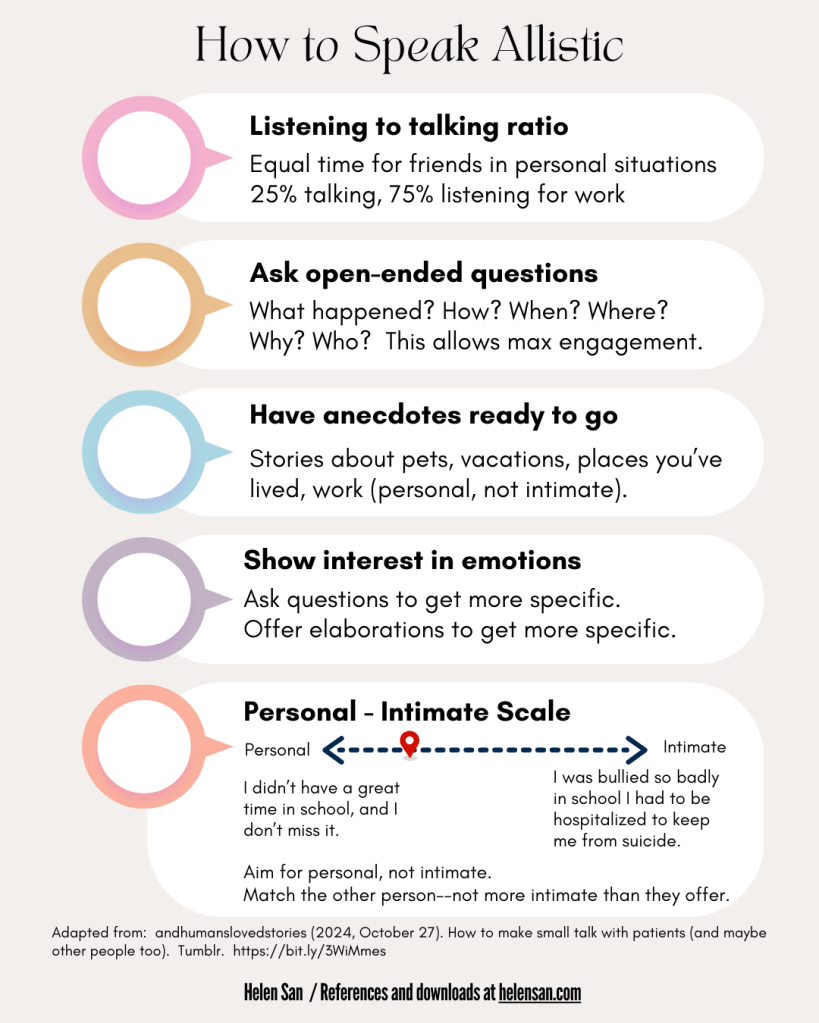
When administering the ADOS-2, the examiner notes the amount and quality of overtures, as well as the amount and quality of responses observed. The examiner also notes whether the client asks for information or offers information. These are behaviors that inform the examiner of a communication style that is “Autistic.” By inference, a communication style that is not interpreted as Autistic, would be allistic.
The remarks about intimacy and investment gestures were summarized from my conversations with my son (L. Tucker, personal communications, January 2025). The intent is to illustrate that the level of intimacy and investment can be inferred from the overture to help match the same level of intimacy and investment in the response.
One can stop at simply giving a response: good, or congratulations. The offer of information, or elaboration, extends the conversation and are conversational offers for the other person. Picking one track to ask about is a gesture of accepting that conversational offer.
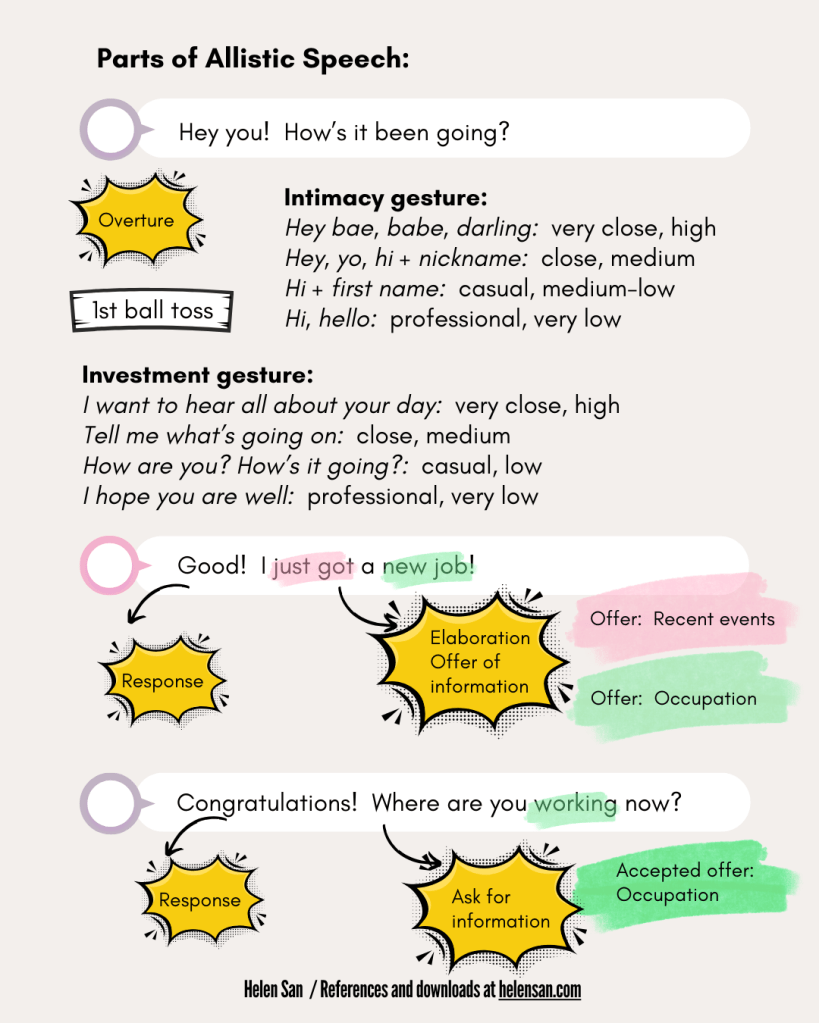
Here is an example of the back-and-forth reciprocity allistics like to engage in for “social use.”
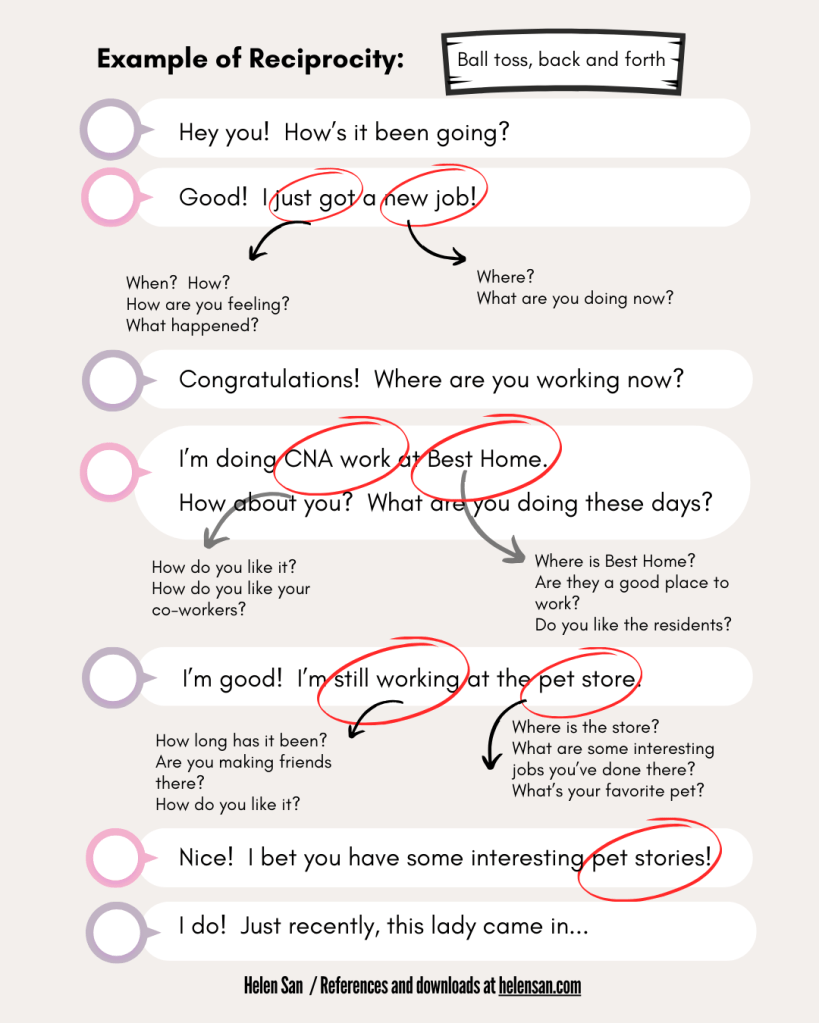
I conceptualize conversations as “ball tossing.” I toss the ball to you, you toss it back, and so forth. Autistic ball tossing tends to center around identifying a puzzle and solving it. In this case, the puzzle is, what is the mechanism that causes someone to throw up while scuba-diving, and how can that be prevented?
Allistic ball tossing tends to center around the emotions and the experiences of the story. It usually is sensitive to not concentrating on any one story too long, and invites the other person to share their story as well.
Monteiro (2024) emphasized that Autistics communicate better when they initate the topics, and if they don’t get to initiate, providing context is very helpful.
Info dumping is a common term in the Autistic community for sharing a trove of information carefully collected through a lot of time, energy, and emotional investment. This trove is Autistic treasure. Interest and asking for details about this treasure trove can communicate affection and investment to the Autistic person.
Because communication can be hard work, some Autistics do not speak, or have times when they do not speak. In those situations, connecting with words, using the preferred alternate language of the Autistic person, is important. Sometimes it can be sitting side by side in silence using the same stim (such as rocking). Sometimes it is sharing the emotions of a series of music videos together. Sometimes it is carrying on a conversation using quotations and lines from a certain book or TV show or movie (using words that have already been written).

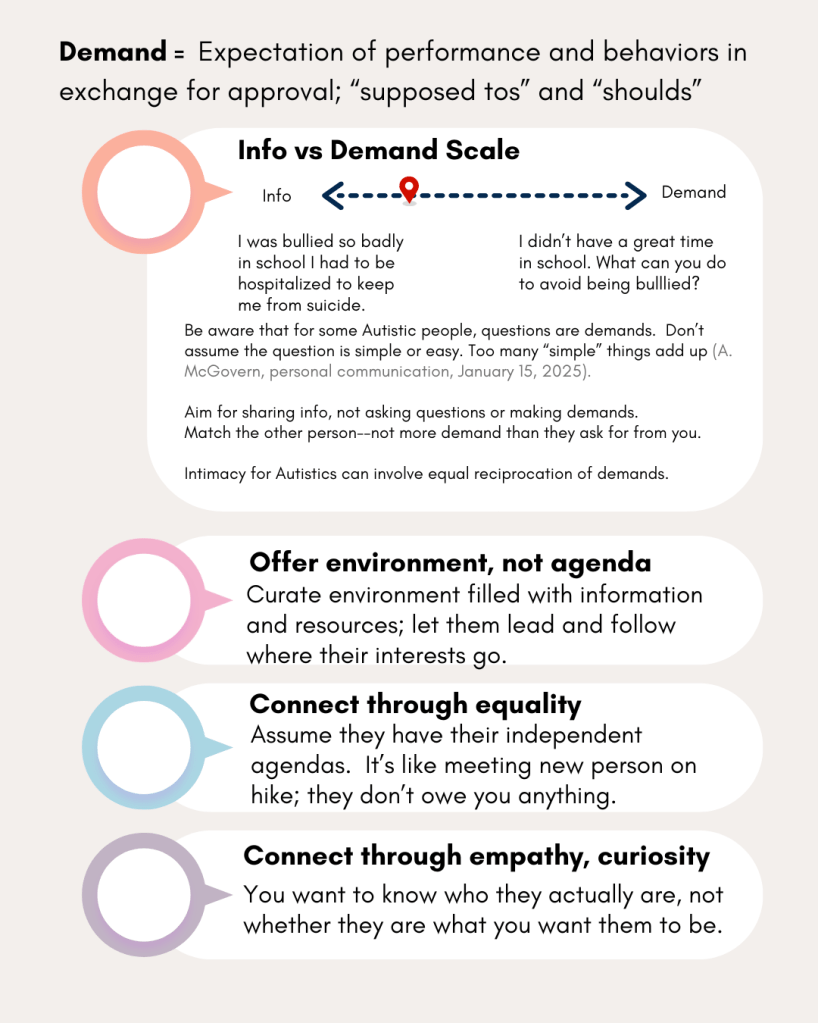
This last page is about communicating with Autistic persons who are overwhelmed by demands from work or school, the sensory environment, and life in general. Overwhelmed by a backlog of demands, these Autistic persons are extra sensitive to demands from their social circles, and may be unresponsive or avoidant to requests from their loved ones. Connecting with them is about not making any demands, not asking for anything or any behavior, and having no agenda whatsoever.
Think of a contrast between school and a homeschooling movement called “unschooling.” School is comprised of a series of structured, timed tasks to complete, first English, then Math, then Social Studies–whether you are interested or not, whether you need extra time or not. Usually, it is one-size-fits-all. Unschooling is comprised of an environment of resources, maybe an English station, a Math station, and a Social Studies station. With no schedule or directive, the student goes to whatever station they feel like, do whatever tasks they feel like, and spend as much time as they want. It is complete autonomy, based profoundly on trust that the student is curious, eager to learn, and is not “lazy.”
Interacting with a demand-sensitive Autistic relies on trust that they deserve to be completely autonomous. This page is not so much a step-by-step prescription as it is a description of an attitude and a different kind of relationship.
andhumanslovedstories (2024, October 27). How to make small talk with patients (and maybe other people too). Tumblr. https://bit.ly/3WiMmes
Lord, C., Rutter, M., DiLavore, P. C., Risi, S., Gotham, K., & Bishop, S. (2012). Autism Diagnostic Observation Schedule, Second Edition. Torrence, CA: Western Psychological Services.
Monteiro, M. (2024, April 30). Using the Adult MIGDAS-2: In Person and Remote Applications. The MIGDAS-2 Diagnostic Interview System Workshop Series.
 Mont Rose Counseling, LLC