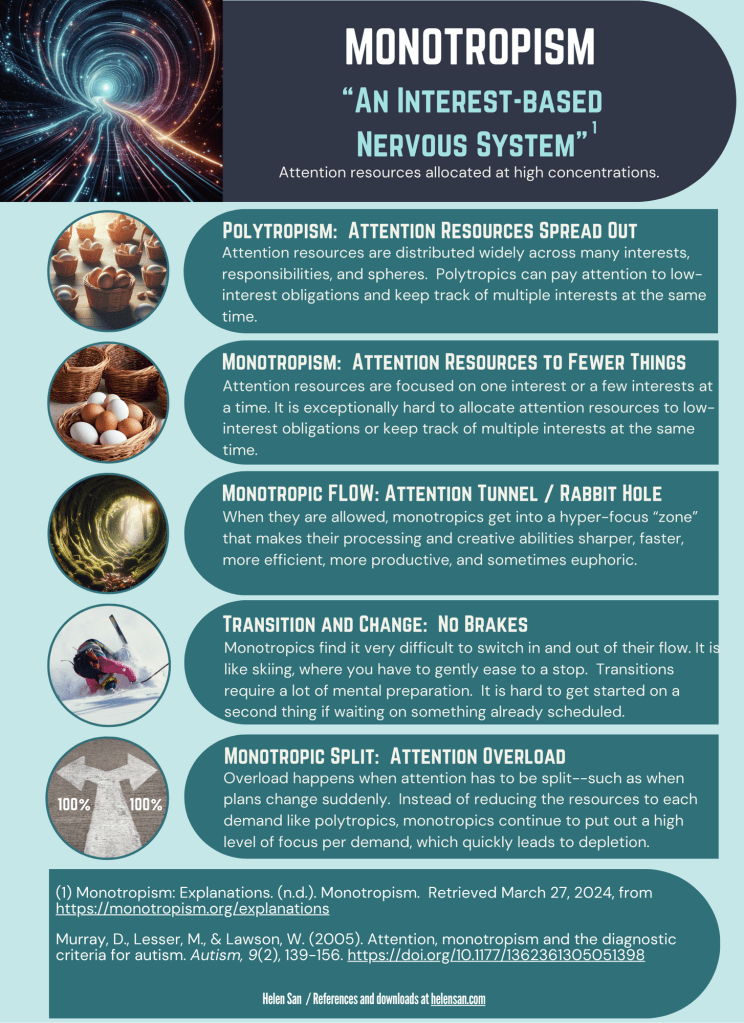
One of the best explanations of the autistic experience came from Murray, Lesser, and Lawson: Monotropism. In this model, attention resources in autism is always highly concentrated. It feels like the autistic brain can’t give less than 100% to anything and can look like perfectionism. In the right circumstances, the monotropic flow state allows a large amount of work to be completed in very short time, and that can feel like one has a “superpower. ” Another characteristic of monotropism is the “brain train,” which can bulldoze over everything and has no brakes. It requires a significant amount of warm-up to change tracks. An environment that requires productivity on demand and is not friendly to monotropic warm-ups and transitions can quickly lead to autistic burnout.
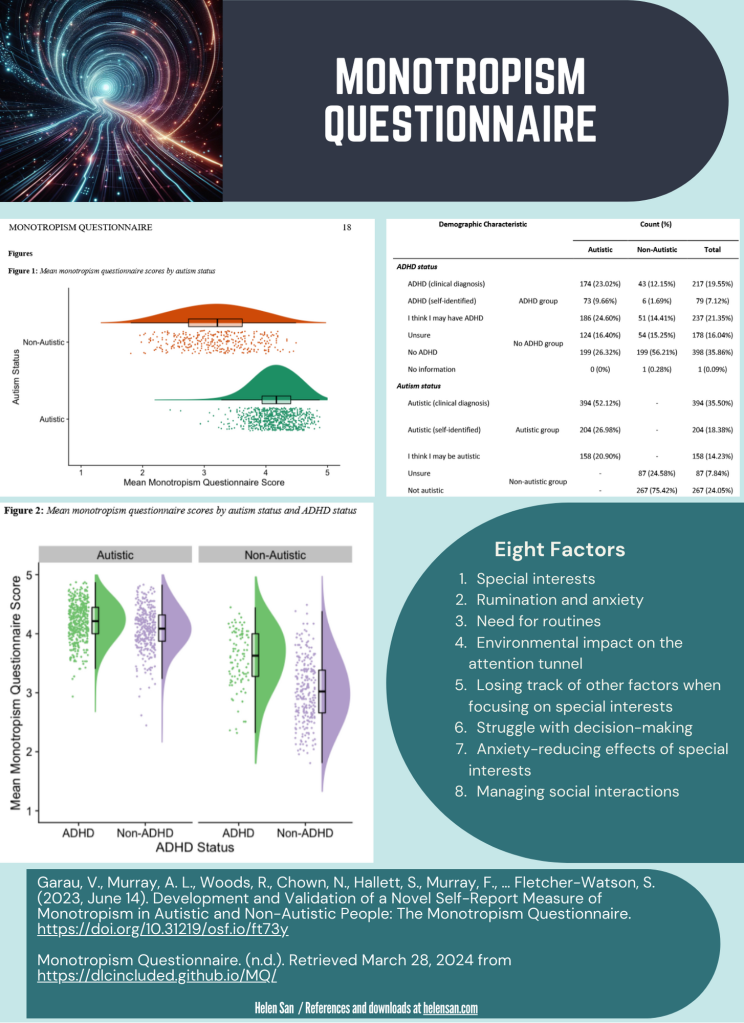
I found the data from the Monotropic Questionnaire especially interesting, as it visually distinguished ADHD and autism and AuDHD.
Take the Monotropism Questionnaire here:
https://dlcincluded.github.io/MQ
References:
Garau, V., Murray, A. L., Woods, R., Chown, N., Hallett, S., Murray, F., … Fletcher-Watson, S. (2023, June 14). Development and Validation of a Novel Self-Report Measure of Monotropism in Autistic and Non-Autistic People: The Monotropism Questionnaire. https://doi.org/10.31219/osf.io/ft73y
Monotropism: Explanations. (n.d.). Monotropism. Retrieved March 27, 2024, from
https://monotropism.org/explanations
Monotropism Questionnaire. (n.d.). Retrieved March 28, 2024 from https://dlcincluded.github.io/MQ
Murray, D., Lesser, M., & Lawson, W. (2005). Attention, monotropism and the diagnostic criteria for autism. Autism, 9(2), 139-156. https://doi.org/10.1177/1362361305051398
Resources with Additional References:
https://www.autisticrealms.com/post/monotropism-questionnaire-inner-autistic-experiences
 Mont Rose Counseling, LLC