All handouts can be shared for free under a Creative Commons license.
I have long described differences between allism and Autism as two different, but equal languages. When Autistics speak allistic, they might speak it with a metaphorical accent or awkward syntax, because it is not their native language. The DSM then grasps these differences as “deficits” in allism.
What the research literature tells us about same-neurotype and cross-neurotype communication (and the “double empathy problem”) is that allistics don’t speak Autistic either, because it is not their native language. They have “deficits” in autism.
Instead of say, looking at native English and Spanish speakers as having “deficits” in each other’s languages, it may be more helpful to look at equally valid differences in their respective languages. Nobody has deficits. We ALL have social skills–they are just culturally different in different cultural groups. Autism is a neuro-culture that has not been recognized enough.
Imagine asking a Spanish-speaker who doesn’t speak English to go to ABA / behavioral modification to get rewards and punishments to speak the “appropriate” way. Contrast this to recognizing that their language is not inferior, but if they want to, here are the resources to learn English.
Autistics have plenty of social skills and relate in a thriving and enthusiastic way with each other. We don’t need to learn allistic, necessarily, especially if one surrounds oneself with only other Autistics or Autistic-friendly interactions. Many of us love learning other languages and choose to learn to be bilingual. Sometimes we speak allistic so well that allistics can’t believe our native language is Autistic. Sometimes we’re told, because we can speak allistic so well, we cannot possibly speak Autistic (because some monolingual brains believe you can only speak one language).
I recommend to all Autistics to find Autistic groups, to find their own neuro-tribe, and feel in a very tangible way, the relief and ease of speaking their own language, and being with people with the same values.
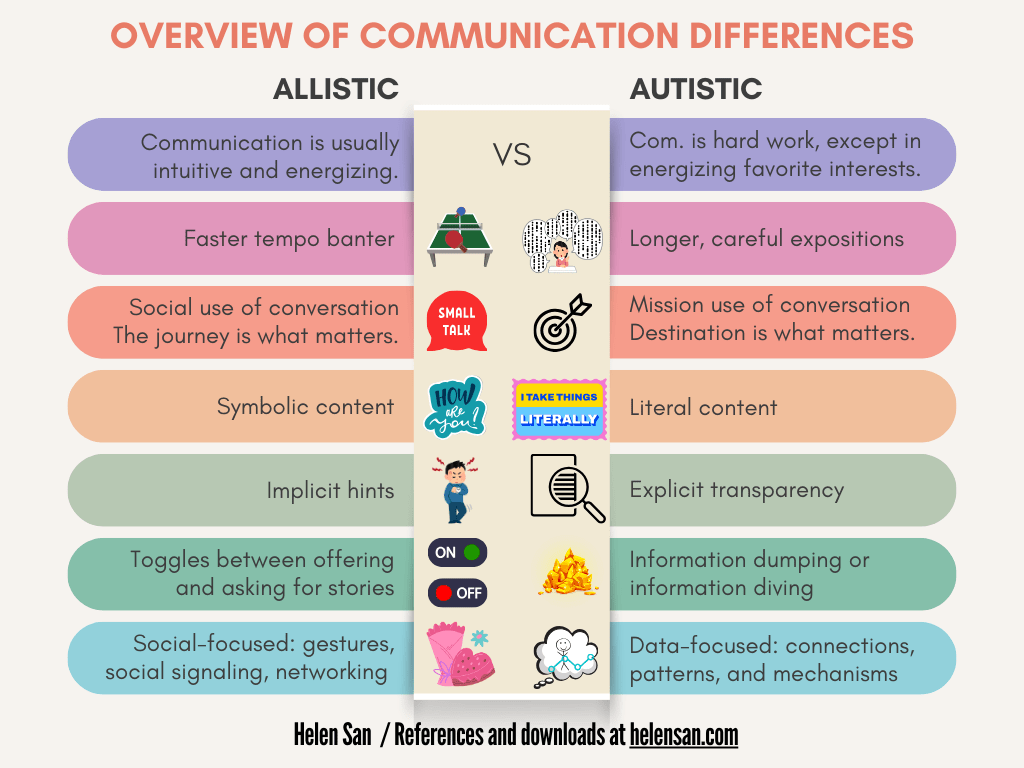
This table is an amalgam of concepts in diagnositic processes and observations in both allistic and Autistic communities. I don’t have references, per se. Monteiro and Stegall (2018) talk about “hard work” in language and communication and Autistic conversations being “object-focused,” (which I changed to “data-focused”). Lord et al. (2012) and Rutter et al. (2003) describe “social use” of conversations.
This is not a comprehensive list, nor does it necessarily apply to all allistics or Autistics. It is intended to provide a broad contrast, at a glance, of our different-but-equal communication cultures.
References
Lord, C., Rutter, M., DiLavore, P. C., Risi, S., Gotham, K., & Bishop, S. (2012). Autism Diagnostic Observation Schedule, Second Edition. Torrence, CA: Western Psychological Services.
Monteiro, M. & Stegall, S. (2018) Monteiro Interview Guidelines for Diagnosing the Autism Spectrum, Second Edition. Torrance, CA: WPS Publishing.
Rutter, M., LeCouteur, A., & Lord, C. (2003). Autism Diagnostic Interview-Revised (ADI-R, ADI™-R) [Database record]. APA PsycTests.https://doi.org/10.1037/t18128-000
 Mont Rose Counseling, LLC