I raised an AuDHD PDA’er, so I have lived experiece with the parental struggles. If I can offer advice from my own personal experience, it would be eliminate the concept of rules, discipline, and punishment. Rewards only don’t work either, because if you think about it, absence of a reward is really a punishment. (E.g. You get your phone after you finish homework really means you are punished with no phone because your homework isn’t done yet.) This does not mean not having boundaries, but that the parent and the child work together to pick the boundaries that make sense to the both of them.
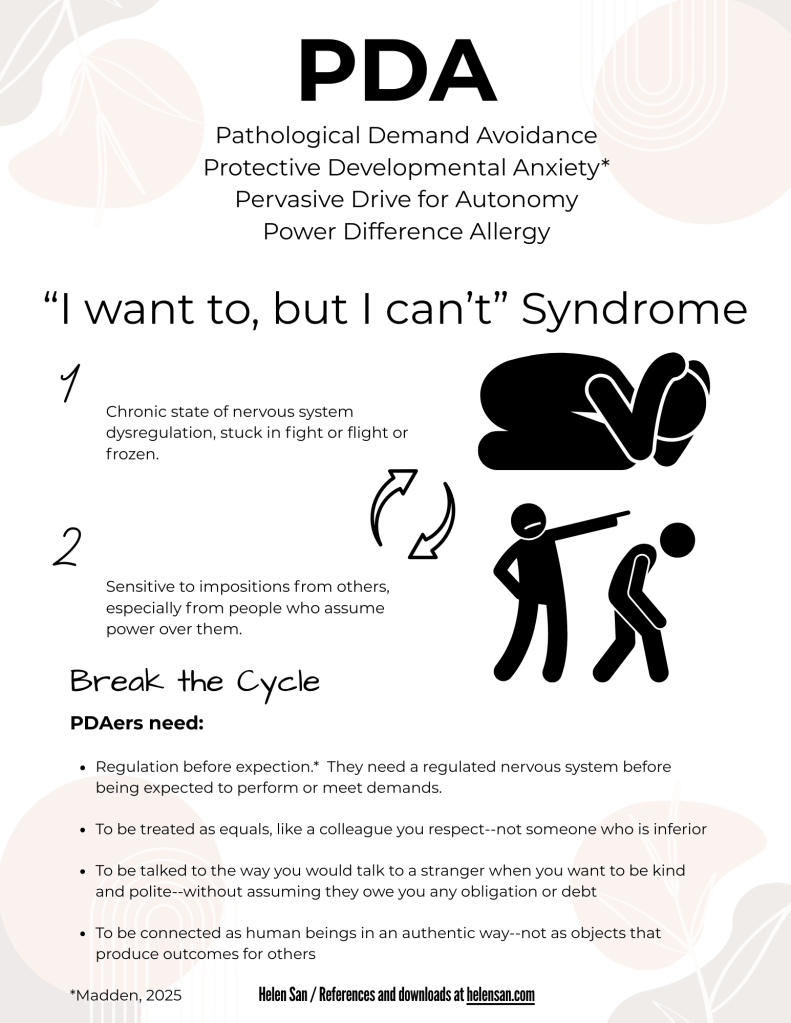
It looks like permissive parenting, except it actually is a commitment to deeper attunement with your child. You would have to grapple with the judgment of other parents who think you are doing it wrong, and find your own confidence that you are doing what is right for your child. Discipline and punishments work with non-PDA’ers whose nervous systems feel safe, so they can learn from such techniques. If a PDA child is stuck in fight, flight, or freeze (FFF), they cannot access their logical, reasoning, planning brain; their bodies react instinctively no matter what their brains tell them to do. Think of a soldier frozen on a battlefield with bullets whizzing by, wanting to run but finding their legs won’t move; or a drowning person who pulls the lifeguard down into the water with them. All the punishment in the world won’t work in that moment. The only thing that works is an eventual sense of safety. Then they can be rational again. Put a pin in this concept: SAFETY. Punishments do not ever make anyone feel safe. Punishments are a contraindication to a need to feel safe.
Allow me to detour for a second. There is a movement called “diaper-free baby” out there where parents try not to use diapers for their babies. What they use instead is deep attunement to their babies’ most subtle signals of needing to go, the slightest baby version of a “pee dance.” The parents notice because they are listening, almost continuously, to this “elimination communication.” When they notice, they put their baby over a baby toilet and help the baby learn to recognize their own signals. Using this method, many parents boast early toilet training at 6 months or never using a diaper at all. It is a different lifestyle, to be devoted to attunement instead of the rule of using diapers. It is not for everyone, but many parents find it creates a profound relationship with their children.
Circling back around to PDA, low-demand parenting, or giving up on punishments, is really about attunement with your children’s subtle signals of safety and FFF, and helping them notice those nervous system signals themselves to create an environment where they feel SAFE: safe from pressure from other people’s expectations and pressure they put on themselves. Just like “elimination communication,” pressure-free communication develops a profound connection with your children, where they are motivated by their relationship and empathy with you rather than any threats you make to their sense of well-being. PDA’ers will go to the ends of the earth for people they feel connected to. Whatever they do, they do out of a fierce love and devotion, not because of fear of punishment. They have to understand WHY something matters, not just that they have to do something. They have to come up with their own solutions that make sense to THEM.
Pressure-free communication can be tricky. Humans have a lot of subtle ways to put pressure on each other. I’ve already pointed out that rewards are just a subtle form of punishment. Praise is another subtle form of pressure. “Congratulations on winning the game!” can feel like a subtle way of saying, “I value winning games, and I hope you work hard to keep winning.” In fact, anything that is focused on certain behaviors or outcomes can be felt like pressure to produce those behaviors and outcomes. A relationship-focused comment might be, “I don’t care whether you won or lost that game. I just loved watching you and how hard you worked at crushing it.”
Because it is relationship-based, pressure-free communication is something that has to be grown organically and sculpted between the parent and the child to fit their dynamics. The attunement just takes a commitment to LISTEN, and let the child tell you what makes them feel pressure-free and SAFE. The underlying foundation of this relationship is providing empathy-based motivation and safe environment for executive functioning to flourish.
Lorraine Madden, a child psychologist in Ireland, has reframed PDA as “Protective Developmental Anxiety.” This reframe reminds us that what looks like anger is really anxiety, and that PDA behaviors (even though many are aggressive) are intended to be protective in that anxious state. Dr. Madden also uses the motto, “regulation before expectation,” to remind parents that helping the nervous system become regulated (get out of FFF and feel settled and connected) comes before the children are able meet any expections for their behaviors.

References:
Klein, A. (2025, March 7). Professionals Breakout Workshop. Conference presentation. PDA North America Annual Conference 2025, Skokie, IL, USA.
Diekman, A. (2025, March 6). Low-demand Parenting. Conference presentation. PDA North America Annual Conference 2025, Skokie, IL, USA.
Madden, L. (2025, November 13). A Whitepaper Reframing PDA: From Pathological Demand Avoidance to Protective Developmental Anxiety. [Conference presentation]. Psychological Society of Ireland Annual Conference, Athlone, Ireland.
Resources:
https://pdanorthamerica.org/ (PDA North America)
https://www.pdasociety.org.uk/ (PDA Society UK)
https://www.amandadiekman.com/ (Low Demand Parenting)
 Mont Rose Counseling, LLC