Myalgic Encephalomyelitis / Chronic Fatigue Syndrome is a condition that sometimes occurs in autistic individuals. Autistic burnout can often look and feel like “chronic fatigue syndrome,” and many autistic individuals in burnout wonder if they have some kind of auto-immune disorder with dysautonomia complicating their recovery from burnout. One study (Quadt et al., 2024) found that neurodivergent traits (autism and ADHD) at ages 7 and 9 were twice as likely to develop chronic disabling fatigue at age 18.
Neurodivergent Insights (Sehinson & Neff, 2024) has an extensive, well-referenced article about the intersection of autism, ME/CFS, and other frequently co-morbid conditions of ME/CFS. The main distinction between autistic burnout and ME/CFS is post-exertional malaise (PEM). In PEM, exercise weakens stamina rather than strengthening it. It is also loosely known as exercise intolerance. Exercise in ME/CFS is like quick sand; the more you move, the deeper you sink. If you don’t have any executive functioning at home, but you feel restored hiking and exercising in the forest, you may have autistic burnout and not PEM.
I was disabled by ME/CFS for 18 years. It has now been in remission since 2012 (14 years and counting). Many people have asked what worked for me. My oldest son also got ME/CFS. What worked for me is also working for him.
Disclaimer: This treatment may simply be a confluence of our personal circumstances and genetics, and may not be applicable to anyone else. Please know this article is not medical advice, but simply a summary of personal experiences. Also, I have no financial ties to any products.
The treatment I used is called grounding. In a 2004 pilot study using only 12 subjects, the authors Ghaly & Teplitz found that 8 hours of grounding during sleep every night for 2 months resulted in normalized cortisol levels compared to baseline. That is, high baseline levels came down, and low baseline levels went up.
When I started grounding, I was not able to walk around the block consistently. After grounding, I walked around the block every day. One block a day turned into 2 blocks, then 3, then 4. Walking turned into jogging. Eight months later, I ran a half-marathon of 13 miles at a 10 minute / mile pace. This was after 18 years of not being able to exercise at all (10 of those years were spent housebound and wheelchair-using when out of the home). My son found himself unable to walk for about a week before he got grounding supplies. After grounding regularly for a year, he feels he has recovered 75% of his functioning.
My son and I have made notes on what types of grounding feels most effective. The following are grounding conditions from most effective to least effective (requiring longer grounding times for the same effect).
- Burying feet in sand/rocks in saltwater (ocean, sea)
- Burying feet in mud/sand in freshwater (river, pond, lake)
- Grounding with wires plugged into grounding outlet using electrogels in metal contact point
- Grounding with wires dry (no electrogel)
- (Grounding while sleeping feels more restorative than grounding while awake.)
- (Grounding with 2 bracelets on both left and right sides of the body feels more restorative than grounding with only one bracelet.)
Here is the product we use for grounding with wires. The bracelets are worn either on both wrists or both ankles. The wires snap onto the bracelets on one end and are plugged into the 3rd hole (the round one) of a 3-prong 120-volt electric outlet in houses built to code in the USA.
https://a.co/d/04fMPS9w
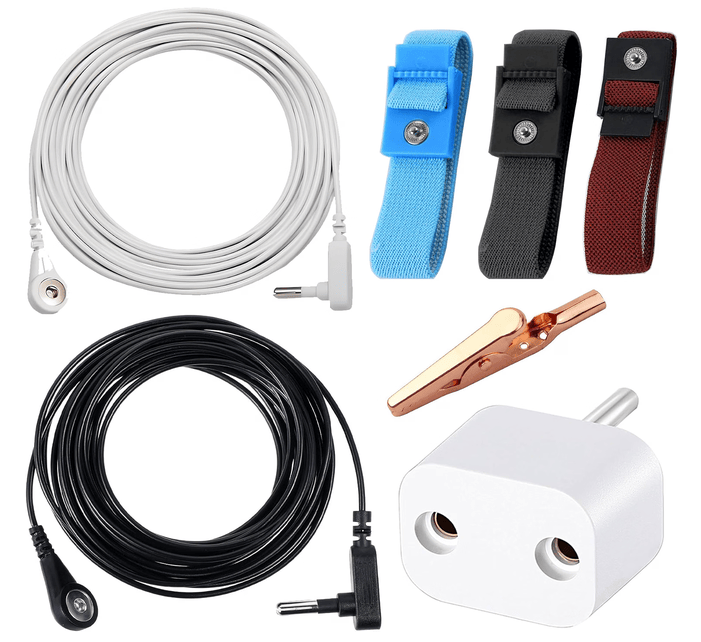
There are many products out there for grounding or “earthing.” Some use sheets or mats. I am not recommending any particular product. This picture and link is simply shared to illustrate that grounding can be very cheap (at the time of this post, it is $18 for 2 bracelets + 2 cables). If done outdoors in a body of water, it is free.
References:
Ghaly, M., & Teplitz, D. (2004). The Biologic Effects of Grounding the Human Body During Sleep as Measured by Cortisol Levels and Subjective Reporting of Sleep, Pain, and Stress. The Journal of Alternative and Complementary Medicine, 10(5), 767–776. https://doi.org/10.1089/acm.2004.10.767 (PDF)
Quadt, L., Csecs, J., Bond, R., Harrison, N. A., Critchley, H. D., Davies, K. A., & Eccles, J. (2024). Childhood neurodivergent traits, inflammation and chronic disabling fatigue in adolescence: A longitudinal case–control study. BMJ Open, 14(7), e084203. https://doi.org/10.1136/bmjopen-2024-084203
Sehinson, C. E., & Neff, M. A. (2024, January 31). Autism and chronic health: Fatigue, illness, and overlapping conditions. Neurodivergent Insights. https://neurodivergentinsights.com/autism-and-health-issues/

