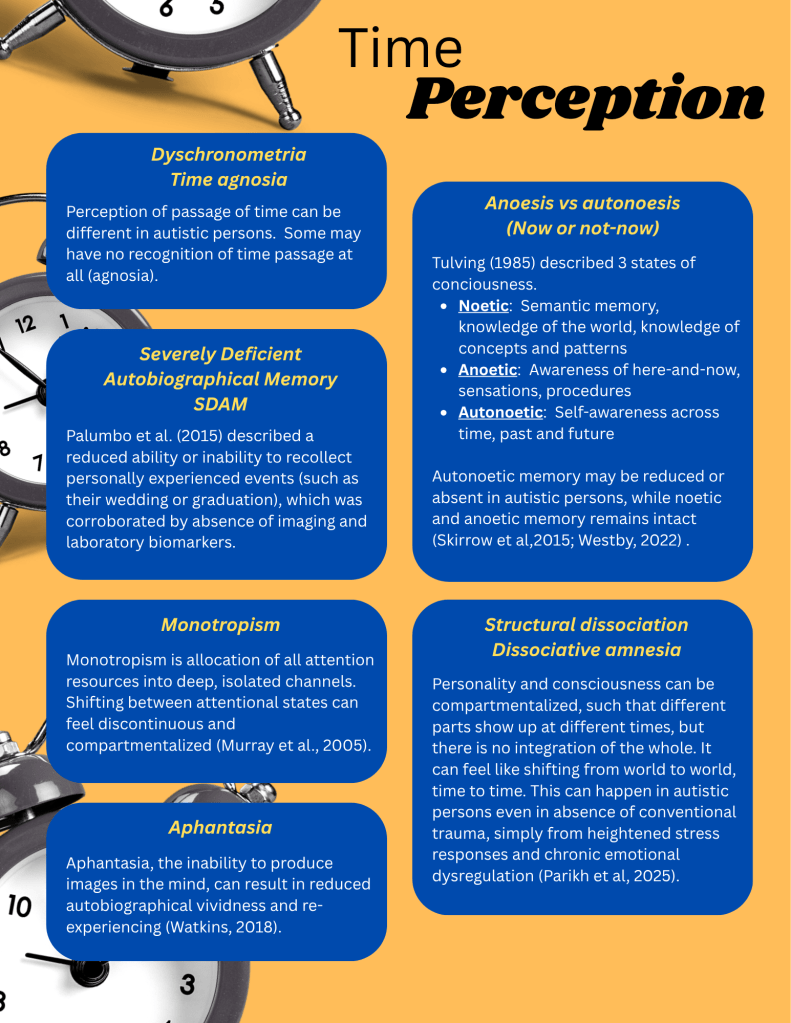
A poorly understood experience for some autistics persons is a reduced ability or inability to recall personal memories, either to re-experience or to use as a point of connection with friends and family (such as, “Remember when we climbed Mount Everest?”). Most autistics with poor to no autobiographical memory rely on memories of patterns and concepts, and stories of the events (semantic memory). Their compensatory strategies are often so effective, others are unaware they have been using prosthetics all their lives.
References:
Casassus, M., Poliakoff, E., Gowen, E., Poole, D., & Jones, L. A. (2019). Time perception and autistic spectrum condition: A systematic review. Autism Research, 12(10), 1440–1462. https://doi.org/10.1002/aur.2170
Murray, D., Lesser, M., & Lawson, W. (2005). Attention, monotropism and the diagnostic criteria for autism. Autism, 9(2), 139–156.
Palombo, D. J., Alain, C., Söderlund, H., Khuu, W., & Levine, B. (2015). Severely deficient autobiographical memory (SDAM) in healthy adults: A new mnemonic syndrome. Neuropsychologia, 72, 105–118. https://doi.org/10.1016/j.neuropsychologia.2015.04.012
Parikh, P., Mathew, N. M., Lee, E., Busaibe, Y., Phagava, T., Wang, E., Bs, R. N., Dua, S. S., & M, M. O. (2025). Management of dissociation in high-functioning autism adolescents. International Journal of Psychology Research, 7(2), 123–126. https://doi.org/10.33545/26648903.2025.v7.i2b.104
Skirrow, P., Jackson, P., Perry, E., & Hare, D. J. (2015). I Collect Therefore I am—Autonoetic Consciousness and Hoarding in Asperger Syndrome. Clinical Psychology & Psychotherapy, 22(3), 278–284. https://doi.org/10.1002/cpp.1889
Tulving, E. (1985). Memory and consciousness. Canadian Psychology / Psychologie canadienne, 26(1), 1–12. https://doi.org/10.1037/h0080017
van der Hart, O., & Steele, K. (2023). The theory of trauma-related structural dissociation of the personality. In M. J. Dorahy, S. N. Gold, & J. A. O’Neil (Eds.), Dissociation and the dissociative disorders: Past, present, future (2nd ed., pp. 263–280). Routledge.
Watkins, N. W. (2018). (A)phantasia and severely deficient autobiographical memory: Scientific and personal perspectives. Cortex, The Eye’s Mind – Visual Imagination, Neuroscience and the Humanities, 105, 41–52. https://doi.org/10.1016/j.cortex.2017.10.010
Westby C. (2022). Nature and Effects of Autobiographical Memory Issues in Persons with Autism Spectrum Disorders. Neuropsychiatric disease and treatment, 18, 2279–2293. https://doi.org/10.2147/NDT.S332521

