The traditional model for “treating” autism is to teach desired behaviors using rewards (in the past, they had used punishments as well). Applied Behavioral Analysis, or ABA, has long enjoyed a “gold-standard” status by the AMA and insurance companies as the “treatment” of choice for autism. In April of 2023, the AMA removed this gold-standard support for ABA because of increasing research demonstrating a strong risk of PTSD in autistic people who received ABA as children. The AMA also changed the language from “treatment of” autism to “support for” autism.
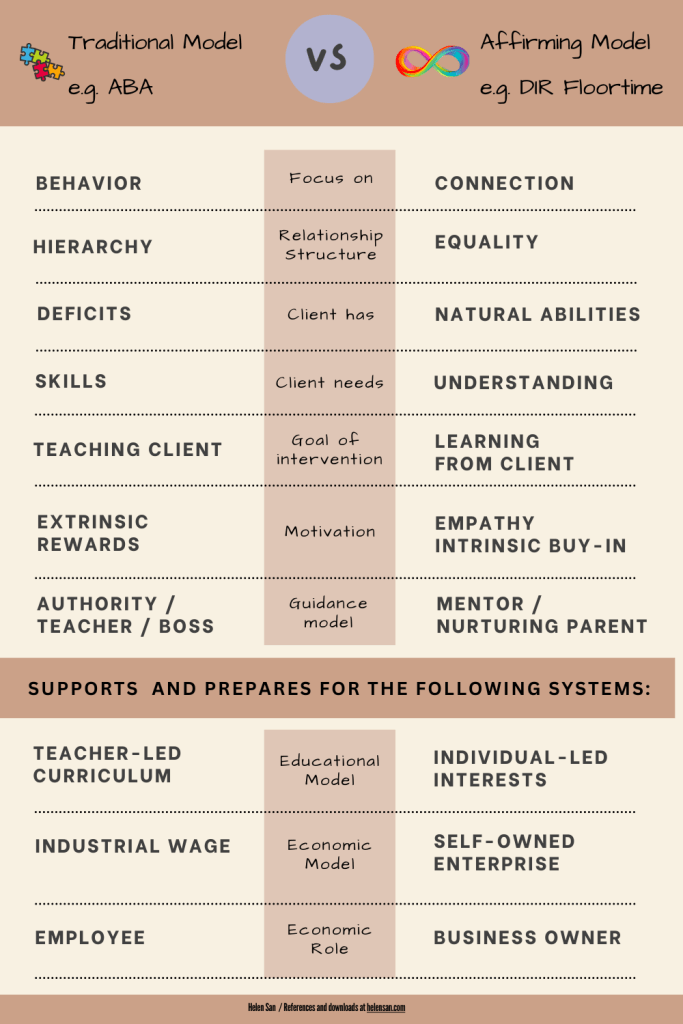
There is emerging awareness in the adult autism community that behavioral interventions and hierarchical structures do not work well in the autistic people. There is a consensus of aversion to shallow behavioral manipulations, including rewards (which also mean punishments in the absence of rewards)–autistics are simply motivated by deeper things like authentic connections and empathy. They do not like to be treated like rats in a lab or robots on the assembly line. There is also an aversion to hierarchy in the intervention, or any implication that two people should not be equal in their connection to each other.
The results are different too. The traditional, behavioral model teaches obedience and compliance. The affirming, connection model teaches listening to one’s own signals, honoring one’s own direction, and learning to self-regulate. It is the difference between the distress of other people controlling and deciding what you are supposed to do and the sense of responsibility that comes with knowing you can steer your own path.
As the adult autistic community becomes more vocal about affirming autism as an equal and different neurotype–not a disorder or condition–it is important that family members and service providers understand the fundamental differences between the traditional model and the affirming model for connecting to autistic people.
In the comparison below, I have listed DIR Floortime as an example of an alternative model to ABA. The affirming model can exist without DIR Floortime, in any interaction, as long as the autistic person experiences a genuine and authetic connection as an equal, motivated by empathy and not an agenda. Affirmation should feel safe and without demand, like home, instead of a carefully manufactured image, like a staged display in a store.
For additional information:
ABA
https://www.autismspeaks.org/applied-behavior-analysis
Removal of AMA support for Applied Behavioral Analysis (ABA) to support autism because of risks of PTSD.
https://www.thelancet.com/journals/lanpsy/article/PIIS2215-0366(23)00405-4/fulltext
DIR Floortime
DIR Floortime research: https://www.icdl.com/research
Buttons under construction.
 Mont Rose Counseling, LLC