Astrocyte Neuron Lactate Shuttle (ANLS) alongside
Novelty Interest Challenge Emergency (NICE)
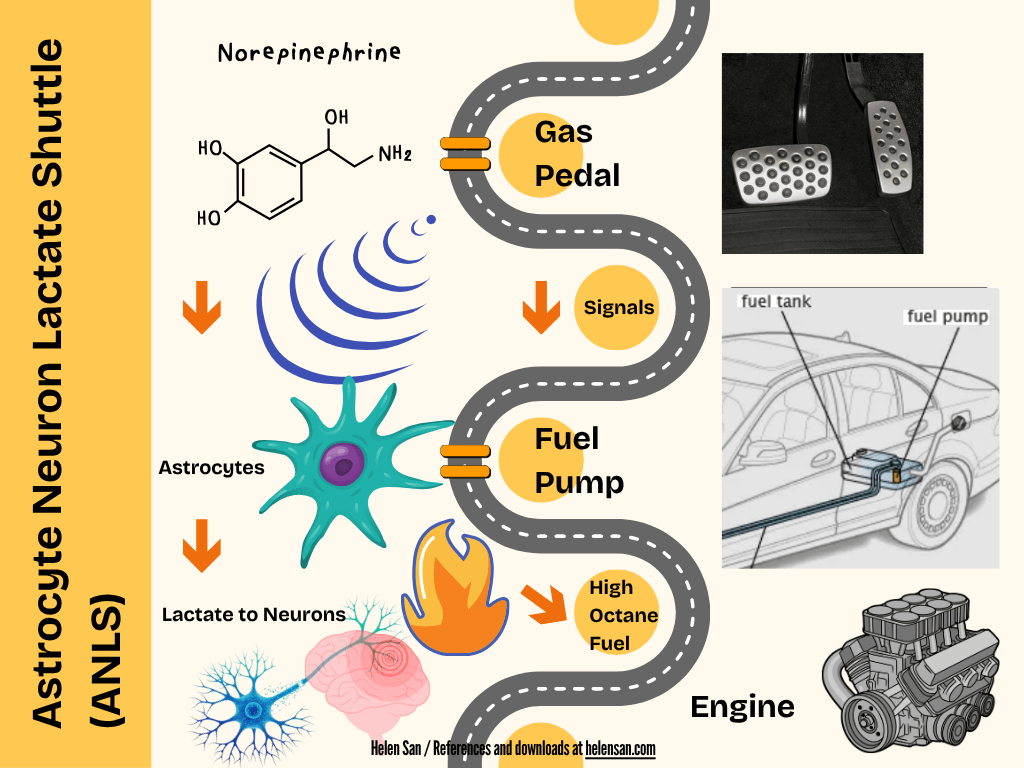
The Neuroenergetics Theory of ADHD (Killeen et al., 2013) identifies the Astrocyte-Neuron Lactate Shuttle (ANLS) (Pellerin & Magistretti, 2011) as being different in ADHD brains. The ANLS is hypothesized as a fuel system starting with norepinephrine signals to astrocytes, which then signal the release of lactate to neurons to support energy-intensive cognitive processing.
In other words, when your brain is trying to focus, organize, and keep things in mind, it needs an extra burst of energy, a brain version of high-octane fuel. Astrocytes are brain helper cells that deliver this boost fuel as needed. In ADHD, it is thought that these helper cells are delayed or unreliable. ADHD brains may have trouble keeping a steady energy supply, which makes it difficult to push through obstacles. It can look like they are lazy or defiant or not disciplined, when they are really trying their best with sputtering fuel.
Norepinephrine (also known as noradrenaline) is the neurotransmitter that activates those astrocyte helper cells. The role of norepinephrine (NE) is to make decisions on whether tasks offer enough rewards to pursue. If the decision is yes, NE directs all the fuel to the task and suppresses distractions from the task. If the decision is no, NE will take the brain into an exploration phase to search for more rewarding tasks. Van der Linden et al. (2021) described the decision as: “-should I continue to put effort into the task at hand?- vs. exploration, -are there better options for me to engage in?”
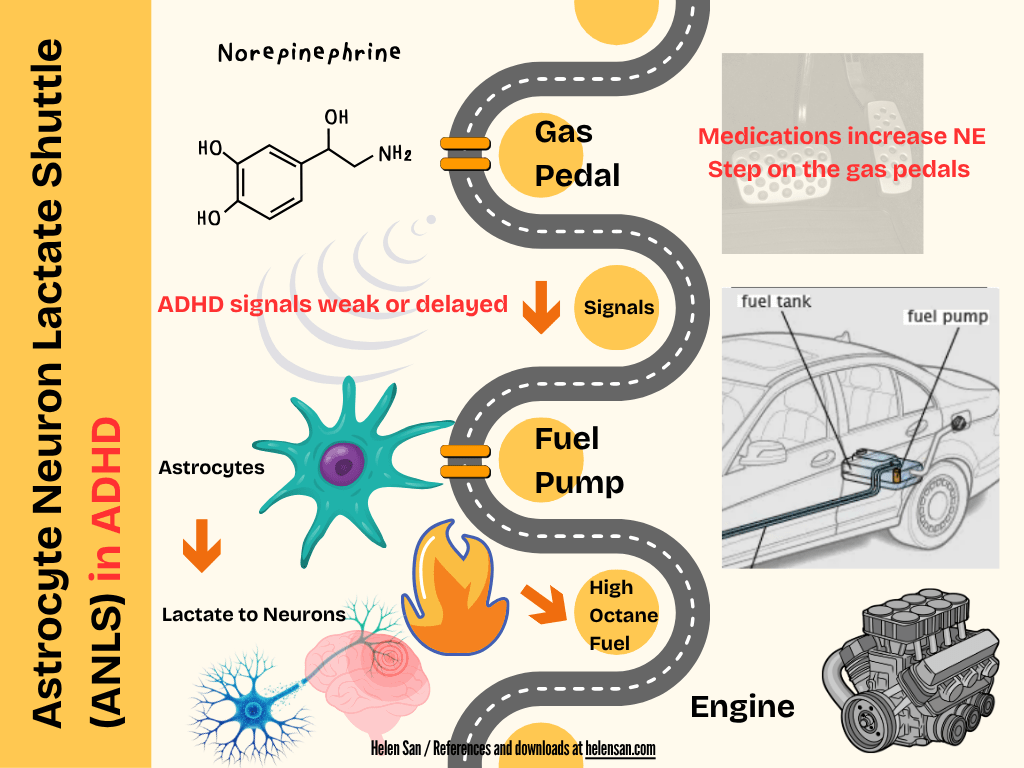
If the decision is yes, the task is worth the effort, NE signals astrocytes to release lactate as a fuel boost. It can be compared to a gas pedal, telling the fuel pump to dispense fuel to the engine. Astrocytes can be compared to the fuel pump that receives the signal. In ADHD, it is hypothesized that the signals from the gas pedal to the fuel pump are weak or delayed, which results in the high-octane fuel being delivered in fits and starts.
ADHD medication often works by increasing NE levels. Some increase background levels of NE (tonic NE), while others increase bursts of NE (phasic NE). This can be compared to holding the gas pedal down for a long time to compensate for the irregular signaling to the fuel pump. Eventually, the fuel pump gets the message, and the fuel is delivered in a more steady manner.
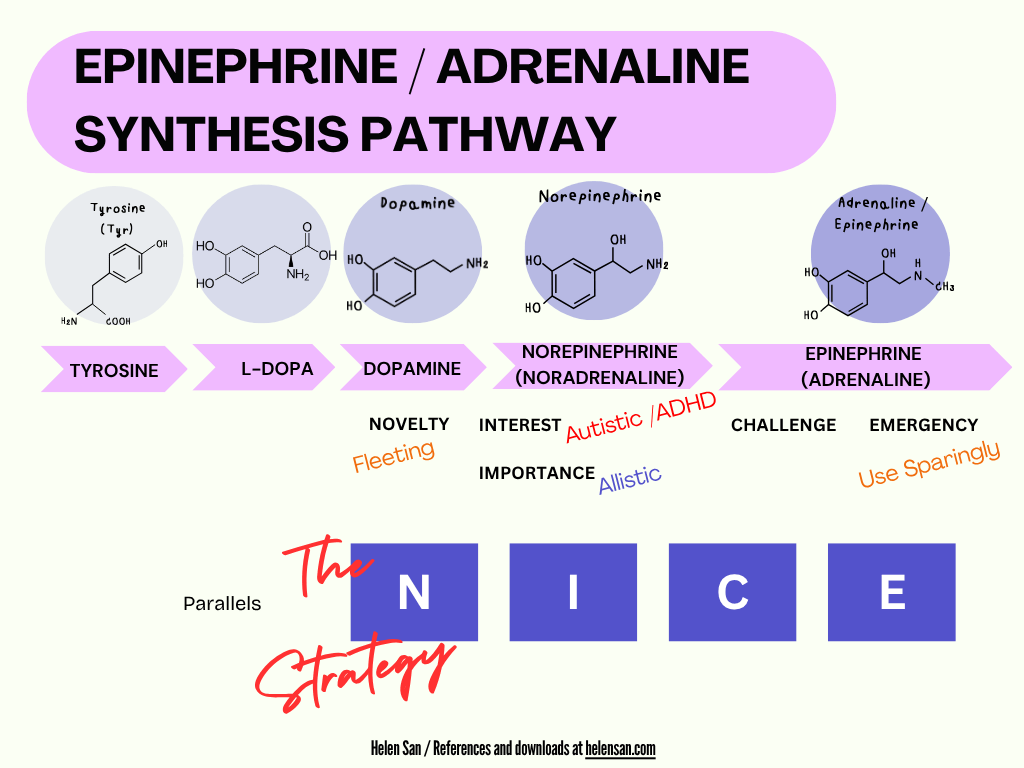
NE is an intermediate in the epinephrine (adrenaline) biosynthesis pathway. The pathway begins with the amino acid tyrosine, which is converted into L-DOPA, then dopamine, then norepinephrine, and finally, epinephrine. (Collectively, they are called catecholamines.)
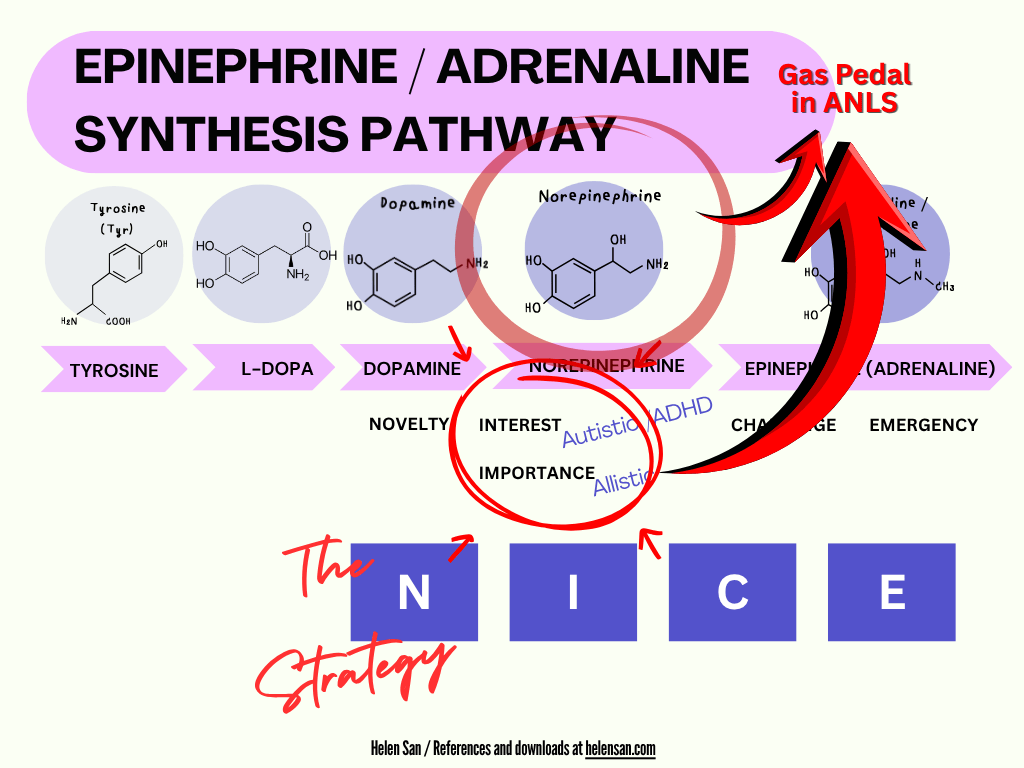
It is well-known that ADHD brains respond best to tasks that have novelty, interest, challenge, and emergency, task characteristics that lend themselves to the acronym NICE. The NICE strategy can be thought of as a parallel the epinephrine synthesis pathway, with novelty corresponding to dopamine, interest to NE, and challenge and emergency to epinephrine. (Challenge, including dealing with adaptation and difficulties, actually corresponds to NE as well as to epinephrine.)
NE decides what is valuable or engagement-worthy. What is valuable can be different between neurotypes, which some neurotypes valuing usefulness and importance, and other neurotypes valuing attention-getting features (interest). Neff (2024) discusses the difference between ADHD brains with “interest-based nervous systems” versus “importance-based nervous systems.” Of note, she explains that importance-based nervous systems are able to get motivation for rewards and to avoid punishments, but interest-based nervous systems find it much, much harder to motivate that way.
Following this line of thought, it can be conceived that the NE gas pedal in interest-based nervous systems would be interest, and the NE gas pedal in importance-based nervous systems would be importance; and possibly, the opposite fuel does not work in each neurotype. Imagine that importance does not produce NE in interest-based neurotypes, and interest does not produce NE in importance-based neurotypes. You have to match the right fuel to the right engine. If that is the case, trying to motivate an autistic person or ADHDer with rewards and punishments is like trying to put unleaded gas into a diesel engine. It will just mess up the engine. Although this reasoning is hypothetical, it does match the lived experiences of interest-based neurotypes.
References:
Killeen, P. R., Russell, V. A., & Sergeant, J. A. (2013). A behavioral neuroenergetics theory of ADHD. Neuroscience & Biobehavioral Reviews, 37(4), 625–657. https://doi.org/10.1016/j.neubiorev.2013.02.011
Neff, M. A. (2024, June 13). How the interest-based nervous system drives ADHD motivation. Neurodivergent Insights. https://neurodivergentinsights.com/interest-based-nervous-system/
Pellerin, L., & Magistretti, P. J. (2012). Sweet sixteen for ANLS. Journal of cerebral blood flow and metabolism : official journal of the International Society of Cerebral Blood Flow and Metabolism, 32(7), 1152–1166. https://doi.org/10.1038/jcbfm.2011.149
van der Linden, D., Tops, M., & Bakker, A. B. (2021). The Neuroscience of the Flow State: Involvement of the Locus Coeruleus Norepinephrine System. Frontiers in psychology, 12, 645498. https://doi.org/10.3389/fpsyg.2021.645498
 Mont Rose Counseling, LLC