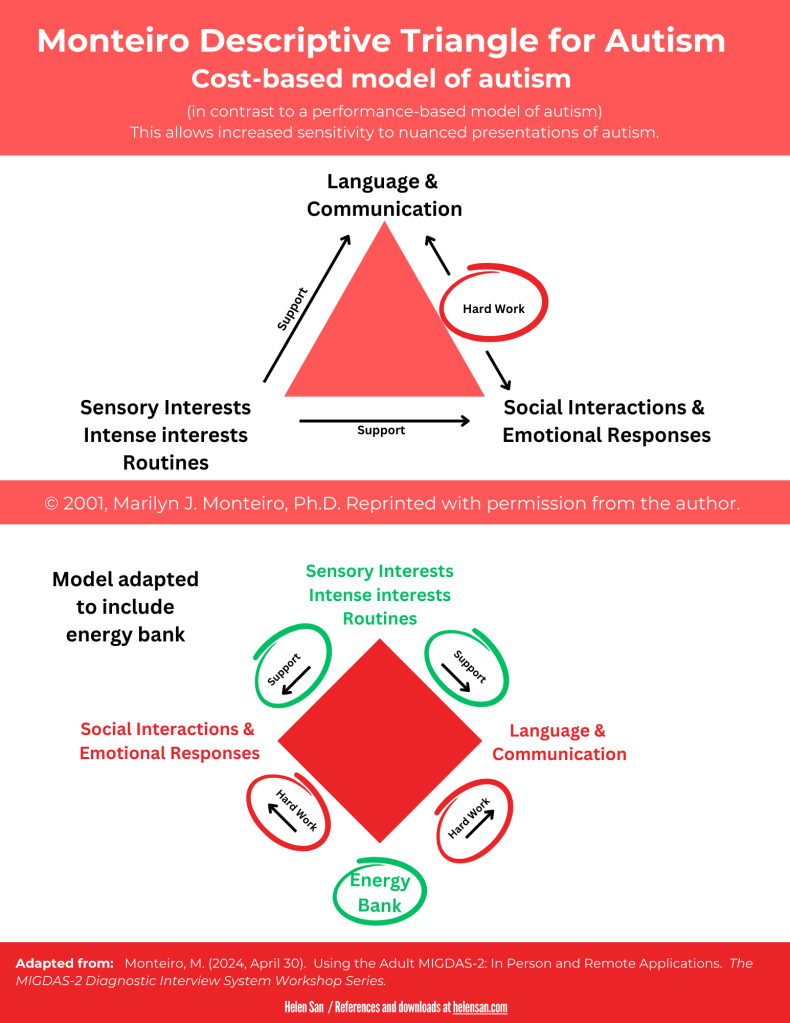
Marilyn Monteiro PhD’s Descriptive Triangle for Autism is the most conceptually elegant and accurate model of autism I have seen to date.
(To be authentically fangirl about this, I spare no hyperbole in saying how excited I am about this model. For me, this is the E=mc2 of autism.)
The reason I think it is brilliant is that it ties current DSM criteria to the lived experiences of autistics. The DSM describes autism as a pattern of “deficits” in performance: language, communication, and social interactions; and sensory interests / aversions, high intensity interests, routines, and repetitive behaviors. Monteiro conceptualizes autism as a pattern in which sensory interests, high intensity interests, routines, and repetitive behaviors help support language, communication, and social interactions, all of which are “hard work” for autistics. That is, autistics perform better with that support than without.
The lived experience of autistics is that performance is variable. Sometimes, there are no deficits to be seen at all–and people, sometimes autistics themselves, wonder if one is actually autistic. This is where we get the “nuanced” presentations of autism. (Anthony Hopkins is autistic? No way!)
Other times, when the energy bank and supports are low, language, communication, and social interactions become incredibly hard to perform–and suffers. On a bad day, an allistic might struggle to be as active or enthusiastic in their social interactions, but an autistic might no longer have the energy to engage socially at all.
Always, underneath whatever performance is seen, there is a cost that allistics do not have to pay. What if, instead of looking at variable performance to identify autism, one looked at how much it costs for an autistic person to communicate and socialize in a world not made for them.
The model also beautifully suggests possible underlying mechanisms and directions for solutions. Why does it cost so much to communicate and socialize? And how can cost be decreased? (Contrast this to the deficit model that asks the superficial question, how can we teach the performance other people want?)
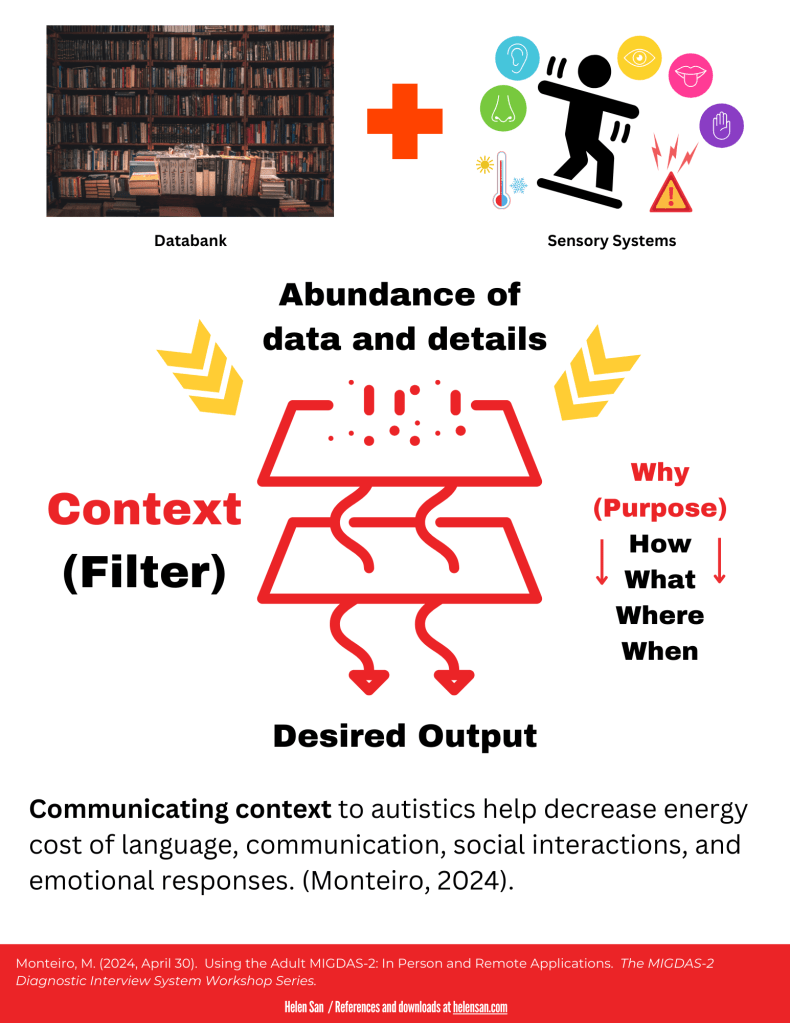
Monteiro suggests part of the reason for the cost and hard work is that the autistic brain is processing an abundance of data and details from accumulated knowledge and sensory systems. Providing context for the communication or social interaction helps the autistic brain narrow down which details to process and gives permission to ignore the rest. For example, explaining upfront, why you are telling the story and what you expect them to do with the story, gives context–a pre-fabricated filter, if you will–that shaves a huge cost of processing right off the top.
A cost-based model redirects the focus in a way that actually feels helpful for autistics in terms of strategies and is consistent with their internal experience of being different, not deficient.
Dr. Monteiro just published a new book summarizing her model, A Clinician’s Guide to Delivering Neuro-Informed Care: Revealing the Autism Story. (Amazon link) Here is my review of her book:
I believe Marilyn Monteiro’s new book is a ‘must-have,’ not just for everyone who assesses autism, but for all clinicians who work with Autistic clients. Her ability to align with, and support, the energy cost of Autistic styles of communication is both ingenious and profound. An example is the use of a ‘pause button’ to gently scaffold conversational topic transitions. Even something as simple as checking for permission and readiness before asking a question shows a deep and compassionate recognition of the Autistic need for mental preparation. Her book consists of accounts of interviewing, assessing, and supporting various Autistic child and adult character composites. These profiles are written in a way that slowly reveals the characters’ stories and how their brains experience the world. Monteiro models a tender approach of report writing that captures the beauty and spirit of her clients, illustrating the kind of report I would love to read about myself or someone I love. This is the first book I would recommend to all clinicians and family members who want to learn kind and nurturing ways to connect with Autistic persons.
References:
NEW! Marilyn Monteiro’s new book: A Clinician’s Guide to Delivering Neuro-Informed Care: Revealing the Autism Story. (Must have!) (Amazon link)
Monteiro, M. (2024, April 30). Using the Adult MIGDAS-2: In Person and Remote Applications. The MIGDAS-2 Diagnostic Interview System Workshop Series.
 Mont Rose Counseling, LLC